
How to Earn Your Google Ads Certification
Looking to get Google Ads certified? Learn how to earn your Google Ads certification in this step-by-step guide.
Google Ads certification is an important credential for marketers.
It is one of the few standardized ways to prove a certain level of knowledge or topical relevance.
While it isn’t an exclusive badge, it requires a certain level of work learning the concepts or experience in day-to-day Google Ads use to attain.
What Is Google Ads Certification?
Google Ads certification is a process by which Google recognizes marketers as experts in online advertising.
After passing Ads certification exams, individuals get a personalized certificate and – if affiliated with a company – can contribute to company Google Partner credentials.
Like many Google products, properties, and initiatives, the program has evolved over the years.
The certification program used to be a standalone program and had a cost attached to taking exams.
That changed with the creation of the Google Partners program and has further evolved with the migration to the Google Academy for Ads in 2018, and more recently a rebrand to Skillshop.
Individual certification still works in very much the same way it did a few years ago with training content and exams (before Google AdWords was rebranded as Google Ads).
However, the connection with the Google Partners program, the move to a standalone platform, and more recent changes over the years can be confusing for individuals and students.
Certification has become a minimum or expected requirement even for entry-level search marketing roles for agencies and corporations over the years.
Even when I hire someone who will go through our training program, I know that they were willing to invest time and see the importance of taking the step of getting certified is crucial.
Having that base level of subject matter exposure from Google is much more specific than what a school textbook can provide on how Google Ads works.
On top of that, there’s value in being able to affiliate that individual who is already certified with my company’s Google Partner account.
This step-by-step guide provides a walkthrough of how to get Ads certified, as it can be a confusing process when doing it for the first time or when coming back and encountering the new system and format in Skillshop.
Step 1: Create or Select Your Google Account
Start by determining the right Google account to use for your certification.
If you work for an agency or a company, you’re likely to be required to use your work email address.
If you’re an individual and doing the certification on your own, you’ll want to pick a Google account that you want to have your certification tied to personally and publicly.
This can be a Gmail account or a Google account that you create tied to any personal email account.
You can easily create a new account at http://accounts.google.com.
Step 2: Get Started in Skillshop
When you have your Google account squared away, make sure you are signed out of any other Google accounts.
Like some other Google products, there can be confusion or login challenges when you’re currently logged into multiple accounts.
When only logged into the account you want to use for certification, go to https://skillshop.exceedlms.com/student/catalog/list?category_ids=53-google-ads.
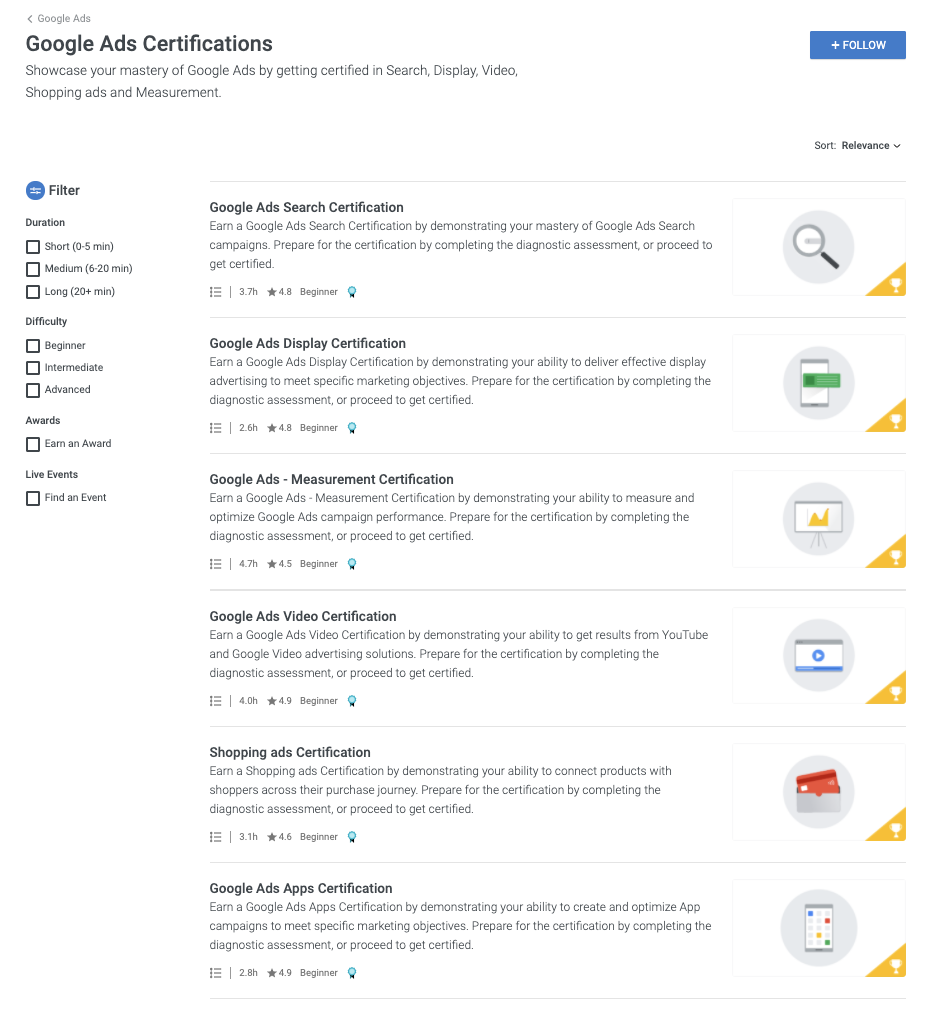
Here you can find the specific certification you want to start with and click into it.
Within the specific certification, read the overview info.
When you’re ready to dive in, click on the Get Started button.
You may be required to authenticate one more time with the Google account you have set up and want to use.
If this is your first time in Skillshop, you’ll also be presented with terms of service to accept.
Once authenticated, you’re presented with an option of sharing your account certification status with your company and Google Partners account (more on that later).
If you’re not a Google Partner or aren’t affiliated with a company, you can select “no” and move past this step in the process. (Plus, you can skip to Step 5 below.)
Step 3: Prepare for Exams
Google provides both basic educational info and their more extensive training content.
The specific Google Ads certifications include:
- Search
- Display
- Measurement
- Video
- Shopping ads
- Apps
If you’re brand new to Ads and the certification exams, I recommend that you start with the Google Ads Search Certification first.
Search ads are typically the most common type of ads a company will run.
But if you are more focused on something like just shopping, then start there.

Training content is tied to each of these specific certifications.
When you click into any of them, you’ll be presented with options to get started that includes a quick knowledge assessment, then other resources.
You’ll need to plan on investing at least a few hours of time to go through the training content specialization.
If you’ve been managing Ads campaigns, or have deeper exposure, it’s still a good idea to go through the modules – even if you do it at a faster pace.
The sample questions are quite helpful – they are written in the same format as they appear on the real exams.
Unless you have previously been certified and/or have a moderate level of Ads experience – don’t skip the training content!
Step 4: Pass the Assessment
To become certified you are required to pass the assessment in any of the respective certification specialties.
Your certification will then be awarded for that specific product focus area.
You can stop with one specialization, or continue by going through additional specializations until you have mastered and achieved all of those relevant for your desired credentials.
If you’re an overachiever or love standardized tests, there’s nothing that says you can’t take them all.
Note that if you fail to pass an exam, there’s a waiting period before you can retry. That’s the only real penalty to not passing.
Step 5: (Optional) Connect with Google Partners
Disclaimer: The Google Partners Program requirements are changing in 2021. They were scheduled to update in mid-2020, but have been delayed. This information is for the current process prior to 2021 updates.
If you want to connect your individual account with your company for credit toward Google Partners and other related benefits, you need to have taken the step of sharing your account with your company.
If you skipped the step or said no, you can go back and do this now.
While still logged into Skillshop, click on your user icon in the top right corner and then on My profile.
Then, you can click Edit profile in the upper right. On this page, you’re again presented with the option to share with your company.
This process requires completion of your profile information that validates and connects you with your company from your end of things.
On the flip side, to validate from the Google Partners side, the administrator of your Google Partners profile will need to ensure that they have created a user account for you in Google Ads and verify they can see it connected in the Partners tab in Google Ads.
That account is to be tied to the company master account that is a Partner, as Google uses this to match up against your Skillshop account.
Again, note that this process is scheduled to change in 2021 along with some of the requirements for partner status.
Conclusion
Once you’ve completed your certification, you should be proud of your accomplishment.
While it is a requirement to be certified by many hiring managers and companies, it still takes effort to go through the learning materials and/or to have been working in Ads for a period of time to pass.
Depending on your role and career path, these can be great additional certifications and specializations to attain as well.
Make note of when your exam certifications expire so you can renew in time.
Also, make note of other exams on Google Ads product specialties in the Ads suite that you can take to further enhance your knowledge and specialization credentials.
Partner companies can achieve specific specializations based on affiliated individuals having passed additional exams on the specific sub-topics providing value for both the certified individual and the company.
More Resources:
- PPC 101: A Complete Guide to Pay-Per-Click Marketing Basics
- 8 Simple Google Ads Tips That Will Make You More Money
- How to Conduct a Complete Google Ads Audit
Image Credits
All screenshots taken by author, July 2020
Why You Don’t Need to Be an Expert in Everything to Be an Effective Strategist
What actually is strategy and why are so many agencies getting it wrong? Read on to learn how marketers should think differently about strategy.

With the rise of automation and the impending impact that it will have on those of us who work in search, one of the things I’ve been focusing on is moving toward a broader, more strategic approach in our work for clients.
I strongly believe the industry should follow suit.
In my last piece for Search Engine Journal, I talked about how we’re going to need to shift our attitudes in paid and focus more on the human side of things, on some of the less “digital” elements.
In many ways, this is best done by starting to focus on strategy – even though that’s a word that’s been, in my opinion, misused for years, especially in agencies.
 The art of war – our job as strategists is to outline the path that leads to victory!
What’s Wrong With ‘Strategy’?
Go into many digital agencies and you’ll find a cohort of people with the word “strategist” in their job title.
Often these will be “PPC Strategist”, “SEO Strategist” or occasionally “Digital Strategist”.
Sadly, a huge number of people who have these titles aren’t “doing strategy” in the way that we need them to, in order to deliver effective results and human-oriented, integrated campaigns for our clients.
Most of them are actually tacticians.
Let’s quote Sun Tzu and the “Art of War” for a moment (incidentally, I have a friend who thinks the whole volume could essentially be a bible for life as a marketer):
“Strategy without tactics is the slowest route to victory. Tactics without strategy is the noise before defeat.”
This sounds impressive, but what does that actually mean?
I’m going to steal from my aforementioned friend who describes the difference between strategy and tactics this way:
“Tactics are how you win the battle. Strategy is how you win the war.”
The point being that strategy is all about your goals and the overarching plan for achieving them.
You’re laying out the path to your objective.
Tactics, are the specific actionable steps you’ll take to get there.
The reason I think we misuse the word in agencies is that we don’t really know what it means.
If I go and ask a PPC Strategist for a client strategy, I’m likely to get a plan, maybe for the next 3-6 months outlining specific actions that they’re going to undertake to hit a client’s KPIs.
Broadly, this is tactics.
Sometimes they might include competitor analysis or industry results, but not always.
If I ask what the client’s core business goals are, or how we’re collaborating with other marketing channels to deliver on these goals (even when those same channels are managed out of a single agency), the answer tends to be that they don’t know.
For those of us who work in marketing, regardless of which discipline or the scope of our roles, strategy should always be about the big picture.
What is it that truly matters to the client, and how we use the resources at our disposal to get them to where they want to be.
The steps that get you there are tactics. We need to, “think strategically, act tactically”.
 A strategist’s job is to find the right direction and lay down the path – not every step between here and the goal.
‘I Can’t Be a Strategist’
I’ve spent a lot of time in a bunch of agencies during my career.
We are starting to see a big shift towards fewer siloes and more integration which is going to yield significantly more effective results for clients and higher job satisfaction if we do it properly.
But the biggest barrier we face to doing this is a lack of strategists.
Agencies feel like they need to have all of the pieces and personnel in place before they shift to these more strategic approaches, but because strategists are hard to find, agencies don’t change and neither does our work.
I speak to so many people who are genuinely excited by the idea of doing proper strategy, really getting to know a client’s business and how they can make a difference to it.
Yet I receive an almost universal response of:
“I’d love to, but I can’t be a strategist because I’m not an expert in everything/I don’t know enough about every channel.”
I’m here to tell you, that particular line of thinking is wrong.
One of the most wonderful things about search, whether paid or organic, is how comparatively well rounded it makes you – for working only in a single discipline.
With enough time in your role, you’re likely to touch a huge number of areas that can give you many of the skills needed to develop your strategic thinking.
Let’s dig into them a little.
Data & Analytics
A staple for any search marketer – the work we do daily with data and analytics helps us interpret data, business insights, and more importantly, do so in an actionable way.
Merely stating numbers isn’t enough – we have to provide a “so what.”
Customer Data & Insights
Anyone who has spent time working on paid search will know how important these are.
We can use this data in a number of ways, but the exposure we have to it gets us thinking about things like customer personas, how to segment user data, and how user needs may differ depending on what group they’re in.
You can see how these are important skills that can easily be applied to strategic work.
The Website
Without websites, we wouldn’t have jobs!
But the work we do around sites often goes hand in hand with CRO, making landing page recommendations, looking into UX, and much more.
When we think about strategy’s role of being that of solving business problems, being able to look at the whole customer journey from end to end, including the website is incredibly powerful
Industry & Competitor Research
This is definitely an area where those of us from a search background can shine.
A huge part of our jobs is looking into what’s happening, both within the industry and competitors.
A big part of putting together a solid strategy is:
- Understanding the macro and micro factors affecting our clients.
- Being able to take the skills we have in analyzing a competitor’s backlink profile or content.
- Applying the same skillset on a broader level.
You Don’t Have to Be an Expert in Everything
While you likely won’t be an expert in all of those areas, you will know enough to ask the right questions – and for me, that’s really what Strategy is about.
Curiosity, imagination, and using questions to guide to the right answers are essential.
You don’t need to be an expert in everything – you can take the deep expertise you’ll have in one area still use that to be very effective, honing your skills and learning more as you go.
I also don’t see Strategy as a solo effort – you don’t need to be an expert in everything because you’ll be working with a team of people who are experts at what they do.
Your role is shaping the conversation and channeling everyone down the road to come up with a plan that is strategic, rather than tactical.
While you will come up with the strategy, others will need to input and also advise on what’s feasible from a tactics point of view.
In an ideal world, we’d have a sea of graduates that we train in strategy as a specific discipline and I hope that one day we’ll get there, as more and more brands and agencies see the value in a truly integrated, strategic approach.
But until that happens, true strategists will be hard to find, and so we are going to have to adapt and evolve, weaving strategy into our jobs and thinking outside of our channel bubbles until there’s enough of us to make this work.
Let’s not let the perfect get in the way of the good.

What Now?
I believe that to an extent, strategy is everyone’s job.
We may have strategists, who live and breathe it, and who are experts at finding the paths we need to get clients to where they want to go.
But everyone can and should start to think strategically. Whether you work in a delivery team, client services, or in-house at a brand, we all have a part to play.
We need to challenge our thinking – if someone comes to you asking for a PPC campaign, it’s often all too easy and tempting to just give them what they’ve asked for.
But before doing that, the first thing we should do is ask “why”.
- Why do you want to run this campaign?
- What are you hoping to get from it?
- How will it contribute to your overall marketing and business objectives?
- What are those objectives?
- What factors might be impacting on our ability to deliver?
Rather than offering services to clients, think about how you can offer solutions.
Clients who come to us asking for a campaign have problems they need solving and we may have better tools to help them than the one they’ve come in and asked for – but we have to be the ones to challenge and guide our clients.
They don’t know what they don’t know – which is why they come to us as experts in the first place.
I hope I’ve gotten you thinking about what strategy really means and the place it should have for all of us.
In my next post, I’ll start digging into simple, but effective ways you can start to put together strategies for your clients.
More Resources:
- Why You Need to Improve Your Critical Thinking Skills & How to Do It
- We Call Your Bluff: 5 Digital Marketing ‘Tells’ You Need to Stop Right Now
- The Difference Between Content Marketing & Content Strategy (& Why You Need Both)
Image Credits
Featured Image: Pixabay
In-Post Image# 1: Unsplash
In-Post Image# 2: Unsplash
Subscribe to SEJ
Get our daily newsletter from SEJ's Founder Loren Baker about the latest news in the industry!
0 Comments